
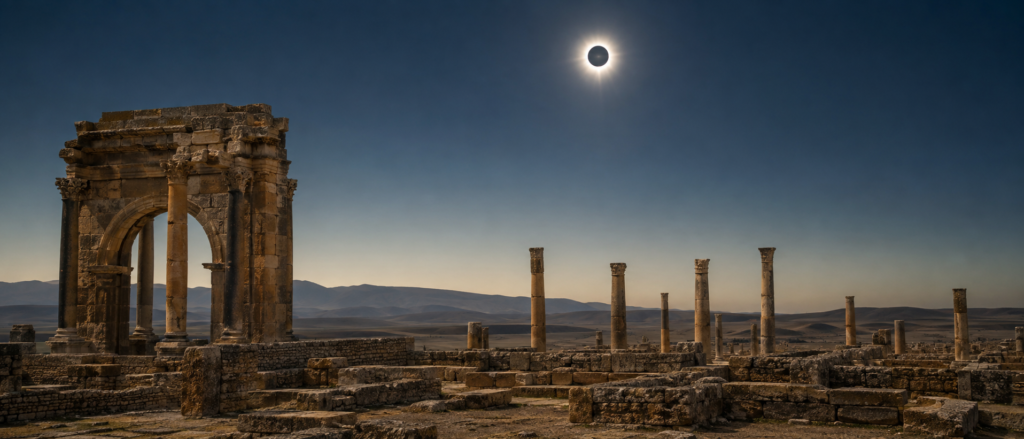
If you are planning to travel for the August 2, 2027 total solar eclipse, Egypt is probably the destination you have heard about most. Luxor sits very close to the center of the eclipse path and will experience more than six minutes of totality, which is extraordinary. Algeria receives less attention, but parts of northern Algeria will also experience more than five minutes of totality, including the area around Timgad and Batna.
So which is better: Algeria or Egypt?
If your only goal is to maximize every possible second of totality, Egypt wins. Luxor will experience approximately 6 minutes 22 seconds of totality, compared with a little over five minutes around the Batna and Timgad area in Algeria. But if the eclipse is part of a larger trip, the decision becomes much more interesting. Algeria offers a less heavily traveled experience, spectacular Roman history, a morning eclipse, and a chance to explore a country that relatively few international travelers have visited.
For me, that is where the Algeria vs Egypt solar eclipse 2027 comparison really starts. I wouldn’t choose between them based on 60 additional seconds of darkness alone.
NASA confirms that the August 2, 2027 total solar eclipse will cross southern Spain and North Africa before continuing through the Middle East, with both Algeria and Egypt directly in the path of totality. You can see the broader path on NASA’s future eclipse calendar.
Egypt Gives You More Totality — and It Is Hard to Ignore
Let’s start with Egypt’s biggest advantage because it is a very good one.
In Luxor, totality is expected to last approximately 6 minutes 22 seconds, with maximum eclipse occurring around 1:05 p.m. local time. Six minutes may not sound dramatically different from five minutes when you are reading about it from home, but during a total solar eclipse every extra second is valuable. For serious eclipse chasers, photographers and anyone who wants to experience one of the longest total eclipses available in our lifetime, Luxor is difficult to beat.
Algeria still gets an exceptionally long eclipse. Around Batna, close to Timgad, totality is calculated at roughly 5 minutes 17–22 seconds, depending on the exact viewing location. Maximum eclipse occurs around 10:03 a.m. local time. That is already far longer than many famous total eclipses people have traveled around the world to see.
I would therefore look at the difference this way: Egypt gives you roughly another minute of totality, while Algeria still gives you more than five minutes. If you are choosing purely as an eclipse chaser, take the extra minute. If you are choosing an entire vacation, I would keep reading.
We have a separate guide explaining what to expect from the 2027 total solar eclipse in Algeria, including the eclipse path and travel considerations in more detail.
The Time of Day Makes Algeria Interesting
There is another difference that I think deserves more attention: the eclipse happens much earlier in Algeria.
Around Batna, maximum eclipse occurs shortly after 10:00 in the morning. In Luxor, it happens at approximately 1:05 in the afternoon. That matters because August in North Africa is hot, and Luxor at 1 p.m. in August can be extremely hot.
Historical climate averages around Luxor show an August high of roughly 106°F / 41°C, while the Batna region averages closer to 94°F / 34°C. These are climate averages rather than a forecast for eclipse day, but they show how different the conditions can be.
Neither destination should be described as cool in August. Algeria’s official tourism information specifically notes that the Batna and Timgad high-plateau region can be hot in summer. The difference is that an eclipse around 10 a.m. in the higher Aurès region may be considerably more comfortable than standing outside near Luxor around the hottest part of the day.
For families, older travelers or anyone who simply doesn’t enjoy extreme heat, I would consider this a real advantage for Algeria rather than a minor detail.
What About the Weather?
Weather is probably the most important factor nobody can guarantee.
You can have the best hotel, the perfect viewing site and expensive camera equipment, but if a cloud appears in front of the Sun during totality, none of those things matter very much.
The good news is that both destinations have very dry summer climates. Luxor receives almost no measurable rainfall in August, while the Batna region is also generally hot and dry during summer. Historical eclipse data from Timeanddate shows very low historical cloud frequency around both locations on August 2, although past weather can never guarantee what will happen in 2027.
I would therefore not choose Egypt over Algeria, or Algeria over Egypt, because someone claims one destination is “guaranteed” clear skies. There is no such thing.
What I would care about is whether the tour has some flexibility in the final viewing location. A beautiful hotel is nice. Being able to move if local conditions look better somewhere else on eclipse morning is nicer.
Egypt Will Almost Certainly Feel Busier
This is impossible to predict precisely because nobody knows exactly how many eclipse travelers will arrive in each country in August 2027. But there is a major difference between Egypt and Algeria before we even talk about the eclipse.
Egypt already receives many times more international tourists than Algeria. UN Tourism recorded roughly 15.8 million international arrivals in Egypt in 2024, while Algeria’s tourism ministry reported about 3.5 million travelers crossing into Algeria that year, including around 2.45 million foreign visitors.
Luxor is also one of the most famous archaeological destinations on Earth. Add one of the century’s longest total eclipses to the Valley of the Kings, Karnak and Luxor Temple, and I expect demand to be enormous.
That doesn’t mean Algeria will be empty. Once eclipse travelers realize that northern Algeria receives more than five minutes of totality, accommodations, guides and transportation around good viewing areas could fill quickly as well.
But Algeria normally operates on a very different tourism scale. You are much less likely to feel that the entire country has been organized around mass tourism, which is something I personally like about traveling there.
If you want huge eclipse gatherings and the excitement of being surrounded by thousands of people who traveled specifically for the event, Egypt may actually be more fun. If you prefer a smaller, more unusual trip, Algeria starts becoming much more attractive.
Egypt Has Easier Tourism Logistics
This is where I would give Egypt another clear advantage.
Egypt has spent decades handling large numbers of international visitors. Cairo is a major international gateway, Luxor has its own airport, there is a huge range of hotels, and the entire Cairo–Luxor–Aswan tourism route is well established.
That makes Egypt easier for someone who prefers to travel independently or wants to assemble flights, hotels and sightseeing separately.
Algeria requires more planning. International flight options are more limited, visa requirements need to be checked carefully for your nationality, and transportation between places such as Algiers, Constantine, Batna and Timgad isn’t something I would leave until the last minute during eclipse week.
For a normal vacation, that doesn’t bother me. It is part of traveling somewhere that hasn’t been developed around international tourism to the same degree.
For an eclipse, however, I would strongly prefer to have the transportation and local logistics arranged in advance. This is a fixed event. The Moon isn’t going to wait because your driver is late.
One Big Planet already offers private guided tours to Algeria, and our 2027 eclipse travel will build the viewing experience into a broader Algeria itinerary rather than treating the country as nothing more than a place to stand for five minutes.
The Historical Experience Is Completely Different
This may actually be my favorite part of the comparison because both destinations are extraordinary, but they are extraordinary for completely different reasons.
In Egypt, Luxor puts you in the middle of ancient Egyptian history. UNESCO’s Ancient Thebes World Heritage Site includes Karnak, Luxor Temple, the Valley of the Kings and the Valley of the Queens. Few destinations anywhere in the world can compete with that concentration of famous monuments.
Watching one of the longest eclipses of the century and then visiting the tombs of the pharaohs is objectively an incredible trip.
Algeria gives you something different. Timgad was founded by the Roman Emperor Trajan around AD 100 and remains one of the clearest surviving examples of Roman town planning. UNESCO describes its grid of streets, public buildings and architecture as an outstanding example of a Roman military colony.
The site sits on the edge of the Aurès Mountains, and the wider region feels dramatically different from Luxor. Instead of pharaonic temples beside the Nile, you are walking Roman streets surrounded by the high landscapes of northeastern Algeria.
I wrote specifically about experiencing the 2027 solar eclipse around Timgad because I think combining more than five minutes of totality with one of North Africa’s great Roman archaeological sites is genuinely unusual.
And Timgad doesn’t have to be the entire trip. Algeria has seven UNESCO World Heritage properties, including Djémila, Tipasa, the Kasbah of Algiers and the M’Zab Valley.
Egypt gives you the pharaohs. Algeria gives you Roman North Africa, Ottoman Algiers, dramatic Constantine and an opportunity to experience a country most travelers still know very little about.
I don’t think there is a wrong answer there.
Is Algeria Cheaper Than Egypt for the Eclipse?
I would be careful with anyone giving you a definite answer to this question right now.
Under normal conditions, Algeria can be a very good-value destination, particularly when compared with highly developed tourism centers. But eclipse travel is not normal travel. Hotels near the path of totality know exactly what is happening on August 2, 2027, and limited accommodation can become expensive very quickly.
Egypt has significantly more tourism infrastructure, which means more hotels, more flights and more competition. On the other hand, Luxor is expected to become one of the world’s major eclipse destinations, so demand could push prices far above normal August levels.
Algeria may avoid some of that international frenzy, but it has less hotel inventory around places such as Batna and Timgad. A smaller number of visitors can therefore fill available accommodation surprisingly quickly.
So I would not choose Algeria because somebody tells you it will definitely be cheaper.
I would choose Algeria because you actually want to travel in Algeria. If it also ends up offering better value, consider that a bonus.
Which Destination Is Better for Photographers?
For a serious eclipse photographer, Egypt’s longer totality is difficult to argue against. Another minute gives you more time to work with different exposures, photograph the corona and actually look up from the camera long enough to experience what is happening.
But photography is about more than the eclipse itself.
Timgad gives you an incredible visual setting of Roman ruins, stone streets and the Aurès landscape. Egypt gives you the Nile, desert scenery and some of the most recognizable archaeological monuments in the world.
There is also the timing difference. Algeria’s eclipse occurs in the morning, while Luxor reaches totality in the early afternoon. The position of the Sun and the surrounding landscape will create completely different photographic possibilities.
Whichever country you choose, remember that photographing the partial phases of a solar eclipse requires proper solar filtration. Never look directly at the uneclipsed or partially eclipsed Sun through a camera, binoculars or telescope without appropriate protection.
So Which Would I Choose?
If someone told me, “I am an eclipse chaser and my priority is getting the longest possible totality,” I would send them to Egypt.
Six minutes and 22 seconds in Luxor is remarkable. The weather prospects are historically excellent, the tourism infrastructure is mature, and you can combine the eclipse with the Valley of the Kings, Karnak, Luxor Temple and the Nile.
But if somebody told me, “I want to see a long total eclipse, but I also want the trip itself to feel like an adventure,” I would seriously consider Algeria.
Five-plus minutes of totality is already exceptional. The eclipse occurs earlier in the day, the Batna/Timgad region is generally less brutally hot than Luxor in August, and you can experience Roman ruins, Algiers, Constantine and other parts of a country that still feels relatively undiscovered by international tourism.
That difference matters to me.
I wouldn’t travel halfway around the world simply to stand in a field for six minutes and then fly home. If I’m going that far, I want the days before and after the eclipse to be part of the story.
Egypt offers one of the world’s great classic journeys. Algeria offers something much less expected.
In simple terms, Egypt is the stronger choice if the eclipse itself is your main priority, while Algeria may be the better trip if you care just as much about what happens before and after totality. That difference is really what the rest of the comparison comes down to.
| Factor | Algeria | Egypt |
|---|---|---|
| Totality length | More than 5 minutes around Batna/Timgad | About 6 minutes 22 seconds in Luxor |
| Eclipse timing | Morning, around 10:00 a.m. | Early afternoon, around 1:05 p.m. |
| August heat | Hot, but generally less extreme in the Batna/Timgad highlands | Very hot, especially around Luxor |
| Crowds | Likely smaller and less mass-tourism focused | Expected to attract very large international eclipse crowds |
| Tourism infrastructure | More limited; better with pre-arranged logistics | Much more developed and easier for independent travelers |
| Historical experience | Roman ruins, Algiers, Constantine, Timgad, Djémila | Ancient Egyptian temples, tombs, Nile, Luxor |
| Best for | Travelers who want the eclipse plus a less-touristed, more unusual trip | Eclipse chasers prioritizing maximum totality and easier logistics |
| Main advantage | More distinctive overall travel experience | Longer totality |
| Main drawback | Fewer hotels, flights and easier-to-book transport options | Heavier crowds and more intense August heat |
Planning a 2027 Solar Eclipse Trip to Algeria
The August 2, 2027 eclipse happens once. That makes planning very different from an ordinary vacation where you can simply move the trip by a week if the hotel you want isn’t available.
Accommodation near the eclipse path, experienced local guides and transportation will become increasingly important as the date approaches. I would not wait until the last few months, particularly if you want a private trip rather than joining a large eclipse group.
One Big Planet offers private travel in Algeria and is developing travel around the 2027 eclipse that combines the event with the country rather than treating Algeria simply as a viewing platform. Our trips can include Algiers, Constantine, Roman archaeological sites and other destinations depending on the amount of time you have.
If you’re still deciding between Egypt and Algeria, start with our complete guide to the 2027 total solar eclipse in Algeria and our more detailed look at the eclipse around Timgad and the Aurès region.
And if Algeria sounds like the kind of trip you want, contact One Big Planet early. Five minutes of darkness may be the reason you go, but Algeria should give you plenty to remember once the Sun comes back.