When you start planning an African safari, one of the first confusing things is all the different names. National park, private game reserve, conservancy, concession, wildlife reserve — they can sound like slightly different names for the same thing. After all, you go there to see wildlife, so how different can the actual safari be?
Quite different, actually.
We have traveled through both national parks and private reserves, and I like them for different reasons. I love the freedom of getting into a car in the morning and spending the entire day looking for wildlife without following somebody else’s schedule. But I also appreciate getting into a safari truck with a good guide and tracker and letting people who know the area do the hard work.
The important thing to understand is that a private reserve does not automatically have better wildlife, and a national park does not automatically mean a budget safari. The biggest difference is usually how you experience the wildlife, how much freedom you have, what kind of guiding you receive and how much you are willing to spend.
If you are still trying to decide where in Africa to go in the first place, our guide to the best African safari destinations for first-time visitors is a good place to start. In this article, I want to focus on the next decision: national park or private game reserve.
What Is a National Park?
A national park is a protected area managed by a government or national conservation authority. Some of Africa’s most famous safari destinations fall into this category: Kruger National Park in South Africa, Etosha National Park in Namibia, Hwange National Park in Zimbabwe, Chobe National Park in Botswana and Amboseli National Park in Kenya are all examples.
National parks are often very large, and that is one of their biggest advantages. You can travel considerable distances, move between different regions and habitats and spend several days exploring without following exactly the same roads every morning and afternoon.
The rules vary between countries, but many national parks also offer more choice in how you travel. In places such as Kruger and Etosha, self-driving is very easy. You rent a vehicle, enter the park and look for wildlife yourself. Guided game drives are available as well, so you do not necessarily have to choose between doing everything independently and having a guide.
We are big fans of self-driving, particularly in Namibia. Etosha is one of my favorite parks because it is easy to explore independently, wildlife gathers around the waterholes, and you can simply stop and wait instead of constantly driving around. I wrote more about why I like it so much in our article about Etosha as a safari destination.
If this kind of independence appeals to you, our Namibia self-drive safari is a good example of how a national-park safari can be part of a much larger road trip rather than the entire vacation.
What Is a Private Game Reserve?
A private game reserve is privately managed wildlife land rather than a public national park. Access is normally restricted, usually to guests staying at lodges within the reserve or to authorized safari vehicles.
This is where things become slightly confusing because there is no single private-reserve model across Africa. Some reserves are fenced. Others are part of enormous open ecosystems where animals can move between private and public land. Some have only one lodge, while others contain several independently operated properties. You will also see terms such as conservancy and private concession, especially in East Africa and Botswana.
The name is less important than understanding how the particular reserve operates.
One of the best examples is Sabi Sands in South Africa. It borders Kruger National Park and forms part of the Greater Kruger wildlife ecosystem. Animals can move through the larger landscape, yet staying in Sabi Sands produces a very different experience from driving through public Kruger.
We already have a detailed comparison of Sabi Sands vs. Kruger National Park, so I will not repeat that entire discussion here. It is simply a perfect illustration of why the land itself is only part of the story.
The Biggest Difference Is Usually Access
National parks have to manage large numbers of visitors while protecting wildlife and vegetation. Because of that, vehicles generally have to remain on designated roads, and public visitors have specific operating hours and park rules.
Most of the time this is not a problem. You can have incredible sightings right beside the road, and animals certainly do not care whether your vehicle is allowed to leave the track. But every safari traveler eventually experiences the frustration of seeing something interesting disappear behind a bush just far enough away that you cannot follow it.
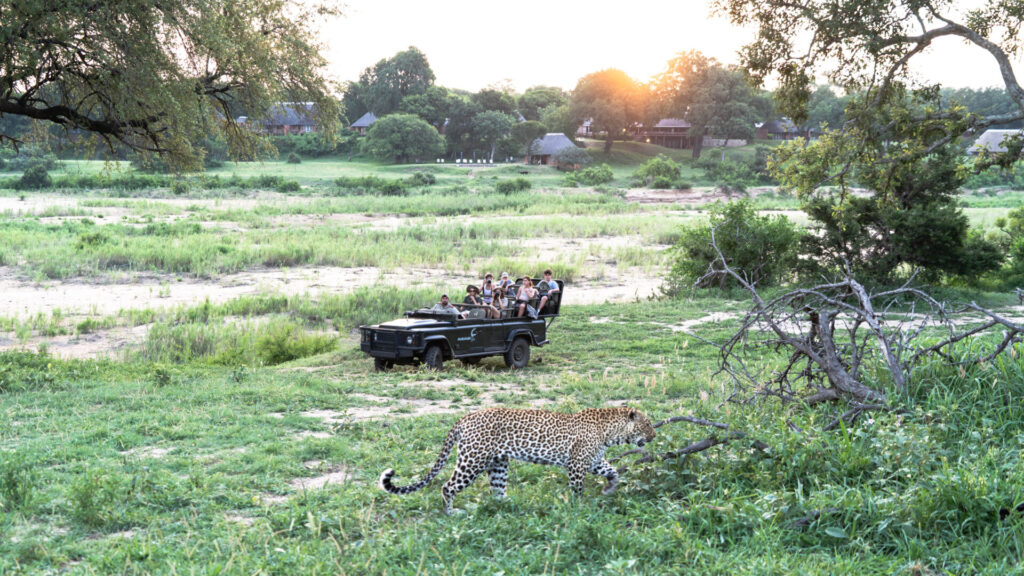
Private reserves can sometimes give guides more flexibility. Depending on the reserve and conditions, guides may be permitted to leave established roads for certain sightings. They also tend to know a much smaller area extremely well and communicate with other guides who are searching for wildlife nearby.
That can make a real difference when looking for elusive animals such as leopards or wild dogs.
However, this is one area where I would be careful with broad statements you see online. Not every private reserve allows unlimited off-road driving, and they should not. Driving everywhere would quickly damage vegetation and disturb animals. Responsible reserves have rules governing when, where and how vehicles may leave established tracks.
So I would not choose a reserve simply because somebody says “they can go off-road.” I would look at the quality of the guiding, the wildlife area and the overall safari experience.
A Good Guide Can Change the Entire Safari
When we first started traveling in Africa, seeing the Big Five was naturally a big deal. With more safari experience, the guide became almost as important as the animals.
A very good guide notices things you would never see yourself. Tracks in the sand, alarm calls from birds or antelope, the direction an animal was moving, fresh elephant damage to a tree, or subtle behavior that tells you a predator may be nearby. A tracker sitting at the front of the vehicle may see a footprint I would drive over without noticing anything.
That knowledge makes private reserves particularly appealing if you have limited safari time. Instead of spending three days learning the roads yourself, you immediately have people whose job is to understand what is happening in the bush.
It does not guarantee animals. Nothing does, and I would be very suspicious of anybody who guarantees a particular wild-animal sighting.
But professional guiding can greatly improve how you experience the safari even when nothing dramatic is happening. After several good guided drives, you also become much better at spotting things yourself.
This is part of the reason we prefer private travel in general. Having more access to your guide and being able to focus on what genuinely interests you makes a difference, which I discuss more in our article about private African safaris versus group travel.
National Parks Give You Something Private Reserves Cannot Always Match: Freedom
This is the part I personally miss when staying at some private reserves.
At a lodge, safari life often runs on a schedule. You wake up early, meet for coffee and leave on the morning game drive. You return for breakfast and have a few hours of rest before afternoon tea and another drive later in the day. It is a very pleasant schedule, but it is still a schedule.
When you self-drive, the day belongs to you.
If you have already seen enough lions and want to spend an hour with a herd of elephants, nobody is waiting to move on. If somebody tells you that wild dogs were seen 20 miles away, you can change your entire plan and go looking for them. If you are tired, you can return to camp. If you wake up and decide that today’s priority is sitting beside one waterhole for four hours, you can do that too.
There is also something satisfying about finding animals yourself. When you turn a corner and suddenly find a lion sleeping beside the road, it feels very different from arriving at a sighting that your guide already knew about.
Neither experience is better. They simply satisfy different personalities.
Private Reserves Usually Feel More Controlled
Popular national parks can get busy. This is especially noticeable when a major sighting happens close to a public road.
A leopard beside the road can attract a surprising number of vehicles very quickly. Sometimes everyone behaves well and you have an excellent sighting. Other times you spend ten minutes trying to look between SUVs while somebody has apparently decided that their car now permanently belongs in the best position.
Private reserves normally control access more carefully. Guides may limit the number of vehicles around a sensitive sighting and rotate so other guests can have a chance.
This does not mean you are going to be completely alone with every lion. You may still share a sighting with other lodge vehicles. But there is usually a difference between controlled lodge traffic and an unrestricted public-road gathering.
For photographers or people who want to spend serious time watching animal behavior, this can be worth paying for.
Night Drives Are Another Advantage
National parks frequently have strict gate hours, particularly for self-drive visitors. Once the gates close, you need to be back at camp or outside the park. Some parks offer official night drives, but you cannot simply drive around after dark in your rental car.
Private reserves commonly continue their afternoon game drive after sunset. That completely changes what you may encounter.
Nocturnal animals become active, predators start moving, and even familiar places feel very different after dark. A good night drive is not simply a daytime drive with headlights. Your guide may use a spotlight to look for eyeshine, smaller nocturnal mammals and predators that become active once temperatures drop.
For someone taking a first safari, I think doing at least one night drive is worthwhile just because it shows you a side of the bush you otherwise would never see.
What About Accommodation?
People sometimes confuse private reserve with luxury lodge, but they are not exactly the same thing.
Private reserves often have more upscale accommodation because the lodge is part of the complete safari experience. Your rate may include accommodation, meals, morning and afternoon game drives, a guide and tracker, sundowners and sometimes drinks or additional activities. Some properties are extremely luxurious, but others are much more relaxed and reasonably priced.
National parks usually give you a broader range. You may find campsites, basic chalets, permanent safari tents, comfortable lodges and high-end accommodation within the same general wildlife area.
Personally, I do not think your bedroom needs to be the most expensive part of your safari. I would rather spend money on a good wildlife experience than on things I barely use because I am outside most of the day.
If you are trying to decide what kind of accommodation suits you, our guide to safari lodges vs. tented camps explains another distinction that often confuses first-time safari travelers.
Which One Is More Expensive?
Generally, private game reserves cost more, sometimes considerably more. But comparing only the nightly room price can be misleading.
A national-park trip may require you to pay separately for accommodation, park entrance fees, a rental vehicle, fuel, meals and any guided activities you decide to add. A private-reserve lodge may put most of those expenses into one rate.
It still does not mean the final prices will be equal. A self-drive national-park safari can be one of the most affordable ways to see wildlife in Africa, while a famous luxury private reserve can cost well over $1,000 per person per night.
There is a very large middle ground between those two extremes.
Our guide to how much an African safari costs goes into the numbers in much more detail and explains why two safaris in the same country can have completely different prices.
When comparing options, look at the complete trip and everything included. A cheap room does not necessarily create a cheap safari, and an expensive lodge is not automatically overpriced if it includes almost everything.
Is a Private Game Reserve Better for a First Safari?
If somebody only had three or four nights for safari and the budget allowed it, I would usually lean toward a good private reserve.
You do not have much time to learn roads, understand animal movements or figure out where sightings tend to happen. You arrive, meet your guide and immediately start your safari. Over three nights you normally get several game drives, professional guiding and enough time to experience both mornings and evenings in the bush.
It is easy and efficient.
If somebody had a week or more, enjoyed road trips and wanted to explore rather than simply maximize sightings, I would be much more inclined toward a national park or a combination of both.
This is also why I don’t normally recommend filling a long Africa vacation with nonstop game drives. Safari is fantastic, but after enough 5:00 a.m. wake-ups, most people appreciate a swimming pool, a city, a beach or simply a morning when nobody expects them to look for lions.
Our article on how many days you really need for an African safari explains how I would balance safari days with the rest of the trip.
Private Game Reserve vs. National Park: Quick Comparison
| National Park | Private Game Reserve | |
|---|---|---|
| Best for | Independence and exploring | Guided wildlife experience |
| Self-driving | Possible in some countries | Usually not |
| Guides | Optional or included with guided safaris | Usually central to the experience |
| Off-road access | Generally restricted | Sometimes permitted under controlled conditions |
| Night drives | Usually only organized activities | Common at many reserves |
| Number of vehicles | Can become busy | Usually more controlled |
| Accommodation | Very wide range | Mostly lodge-based |
| Budget | Usually more flexible | Generally higher |
| Schedule | More freedom | More structured |
| Good for short safari | Yes | Particularly good |
| Good for longer exploration | Excellent | Depends on reserve and budget |
These are general differences, not absolute rules. Every country, park and private reserve operates differently, which is why I would never book based only on the words “private reserve.”
What I Would Choose
For me, it depends on the trip.
If I were going to Namibia for two weeks, I would absolutely want the freedom of a road trip and several days self-driving in Etosha. Namibia is too interesting outside the safari parks to spend the entire vacation following a lodge schedule, and our Namibia tours and self-drive options are designed around exactly that flexibility.
If I were in South Africa and only had three or four nights dedicated to wildlife, I would seriously consider a private reserve. Sabi Sands, for example, offers the professional guiding, tracking and controlled wildlife viewing that works particularly well for a short, concentrated safari. You can see our current South Africa safari and private-reserve options and then add Cape Town or another part of the country instead of spending the entire vacation in a safari vehicle.
If time and budget allowed it, however, I would combine the two.
Spend several days exploring a national park and finding wildlife yourself, then finish with a few nights in a private reserve where somebody else drives, finds the animals and has dinner waiting when you return.
You understand the value of the private reserve much better after you have spent a few days doing the work yourself.
So, Is a National Park or Private Game Reserve Better?
There is no universal winner, and I would be suspicious of anyone who tells you there is.
Choose a national park if you enjoy independence, want more control over your budget, like exploring large areas and, where permitted, want the option to self-drive.
Choose a private game reserve if your priority is concentrated wildlife viewing, professional guiding, fewer vehicles, greater flexibility during game drives and a safari where most of the planning is done for you.
And choose both when the itinerary makes sense.
The animals do not care whether they are standing on public or private land. What changes is your access to them and the way you spend your day.
At One Big Planet, we build both independent and guided African itineraries rather than pushing everybody toward one style of safari. You can explore our African safari destinations or contact us to plan your safari. Tell us what you actually enjoy when you travel, how much time you have and what you want to spend, and we can decide whether a national park, private reserve or combination makes the most sense.