A total solar eclipse is a perfectly good reason to travel somewhere you have never been before. In Algeria in 2027, I think that is actually the best way to approach the trip.
The August 2, 2027 eclipse will cross northern Algeria, and the Batna region is expected to receive a little over five minutes of totality. That alone is enough reason for eclipse travelers to pay attention. But I would not fly all the way to Algeria, watch the Sun disappear for five minutes and then leave. Batna sits in a part of the country where you can combine the eclipse with Roman cities, Constantine, Algiers and the Mediterranean coast, turning one morning of totality into a genuinely interesting week in a country most travelers know very little about.
That is what makes an Algeria solar eclipse trip appealing to me. The eclipse gives you the date and the reason to go, while Algeria gives you everything else.
If you are still researching the eclipse itself, start with our guide to the 2027 Total Solar Eclipse in Algeria. Here, I want to concentrate on the other six, seven or ten days of the trip.
Start With Algiers, Because Algeria Is More Than Desert and Roman Ruins
I would start a first trip in Algiers rather than heading straight toward the eclipse path. It gives you a much better introduction to the country and immediately gets rid of the idea that Algeria is simply desert.
Algiers sits on the Mediterranean, and much of the city climbs away from the waterfront on hills overlooking the sea. The most interesting part for me is the contrast between the older Kasbah, Ottoman history and the broad European-style streets and architecture elsewhere in the capital. You can spend one part of the day walking through a dense historic medina and another looking out across the Mediterranean.
The Kasbah of Algiers is also a UNESCO World Heritage Site. UNESCO describes it as a historic Islamic city containing old mosques, Ottoman palaces, traditional houses and a street pattern that adapted to the city’s steep terrain. More importantly, it is not an archaeological site that stopped living centuries ago. It remains a real neighborhood, which makes visiting it completely different from walking through Timgad later in the trip.
I like beginning here because an eclipse trip can otherwise become overly focused on schedules, coordinates and weather forecasts. Algiers reminds you almost immediately that you have arrived in another country to travel, not simply at an observation point waiting for the Moon.
Then Go Back Almost 2,000 Years at Timgad
Timgad is one of the obvious places to include because it is close to the part of eastern Algeria that interests us for the eclipse, but I would visit it even if there were no eclipse at all.
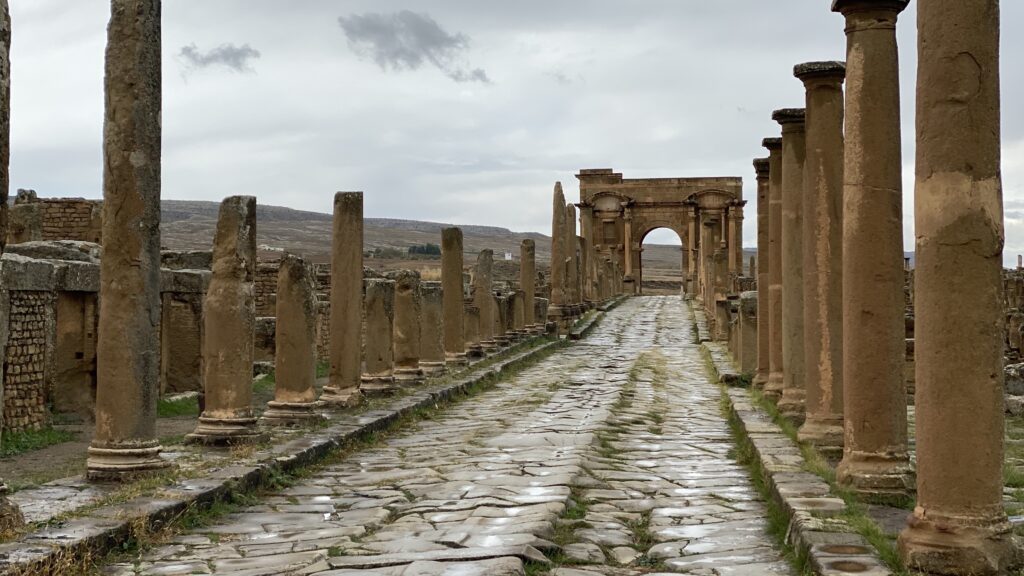
The Romans founded Timgad under Emperor Trajan around AD 100. Unlike a city that slowly grew over hundreds of years, it was deliberately laid out as a Roman colony, which is why the street plan is still so easy to understand when you walk through it today. UNESCO describes the site as an exceptional example of Roman town planning, with the original grid organized around the cardo and decumanus—the two principal streets of a Roman city.
That is what I find particularly interesting about Timgad. You are not looking at one surviving temple surrounded by a modern town. You can actually begin to understand how the city was organized, with streets, public buildings, a theater, arches and neighborhoods spread across an open landscape below the Aurès Mountains.
And then there is the eclipse connection. The wider Batna region sits inside the 2027 path of totality, with Batna itself currently calculated to receive about 5 minutes 17 seconds of totality around 10:03 a.m. on August 2. The precise viewing location for an eclipse trip should be selected based on conditions and logistics rather than simply standing inside the archaeological site, but geographically the two experiences fit together very naturally.
We looked at that combination in much more detail in our article about the 2027 solar eclipse around Timgad and Algeria’s Roman history.
Don’t Stop at Timgad — Djémila Is a Completely Different Roman City
If you have already seen one Roman ruin, it can be tempting to think you do not need another. I would make an exception for Djémila.
Timgad and Djémila are both Roman cities and both UNESCO World Heritage Sites, but the experience is quite different. Timgad is famous for the clarity of its planned grid. Djémila was built in mountainous terrain at about 900 meters above sea level, forcing Roman urban planning to adapt to the landscape rather than simply imposing a neat rectangular plan on flat ground.
The ruins include forums, temples, basilicas, arches, houses, a theater, baths and significant mosaics. UNESCO specifically highlights how well the Roman city was adapted to its mountain setting, which is exactly why I would combine the two instead of choosing between them.
You begin to see Algeria’s Roman history as something much larger than one famous archaeological site. North Africa was a substantial part of the Roman world, and traveling between these places makes that history much easier to understand than seeing a few isolated objects inside a museum.
For anyone who likes archaeology, I think Timgad and Djémila together are one of the strongest reasons to turn the eclipse into a proper Algeria journey.
Constantine May Be the Place You Remember Most
Then Algeria changes again.
Constantine is not a Roman ruin or a Mediterranean resort town. It is a living city built around the enormous Rhumel Gorge, with neighborhoods connected by bridges stretching across the canyon.
This is one of those places where photographs actually make you want to see whether it looks that dramatic in real life. The official Algeria tourism site describes Constantine as a clifftop city linked by bridges, with a history reaching back to ancient Cirta and later Roman rule.
For me, the reason to put Constantine into an eclipse itinerary is contrast. After days involving archaeological sites, you suddenly have a city where the landscape itself dominates the experience. You can walk historic streets, see the bridges from different viewpoints and experience an Algeria that feels completely different again.
This is also why I do not love itineraries that simply collect UNESCO sites. The best trips have a rhythm. A Roman archaeological site followed by another Roman archaeological site followed by another ruin can eventually turn into one long history lesson, no matter how important the places are. Constantine breaks that up.
Tipasa Gives You Roman History on the Mediterranean
If you have time around Algiers, Tipasa adds yet another version of Algeria.
Tipasa lies roughly 70 kilometers west of the capital on the Mediterranean coast. Its history includes Punic, Roman, early Christian and Byzantine periods, and UNESCO describes it as an unusually rich archaeological landscape showing interaction between indigenous North African cultures and successive Mediterranean civilizations.
What makes it attractive on this particular trip is the setting. After seeing Timgad against the Aurès Mountains and Djémila in the highlands, you are now looking at ancient remains beside the Mediterranean.
That variety is exactly what surprised me when I first started looking more seriously at Algeria as a destination. On a map, many travelers simply see a huge North African country with the Sahara covering most of it. On an actual northern Algeria itinerary, you are moving between a Mediterranean capital, mountain landscapes, Roman cities, a canyon city and the coast.
That makes the eclipse only one part of a much more varied trip.
The Eclipse May Be Why You Book Algeria, but It Shouldn’t Be the Only Good Day
This is especially important with eclipse travel because there is one uncomfortable reality nobody can change: the weather is not guaranteed.
You can select a location with excellent historical conditions, arrive early, organize transportation properly and still have clouds or dust appear on the morning of August 2. That is why I strongly prefer building an eclipse trip around a destination you actually want to visit.
Imagine two different trips.
On the first one, you fly somewhere because a map tells you it has six minutes of totality. You stay near the viewing location, watch the eclipse and fly home. If clouds arrive, the entire vacation suddenly feels like a failure.
On the second one, you spend a week discovering Algiers, walking through Roman cities, crossing bridges above the Rhumel Gorge and traveling through landscapes you have never seen before. Then one morning, if the sky cooperates, you also stand under the Moon’s shadow for more than five minutes.
I know which trip I would rather take.
This is also the main reason I like Algeria for 2027 even though Egypt receives a longer period of totality near Luxor. We compared the two destinations in our guide to Algeria vs Egypt for the 2027 Solar Eclipse. Egypt is an excellent eclipse destination, particularly if maximizing totality is the priority. Algeria becomes interesting when discovering the country itself matters just as much.
Should You Add the Sahara?
Normally, when someone asks me about Algeria, the Sahara immediately becomes part of the conversation. Algeria contains some extraordinary desert regions, including the M’Zab Valley, Tassili n’Ajjer and the far southern landscapes around Djanet and Tamanrasset.
The M’Zab Valley alone is a UNESCO World Heritage Site about 600 kilometers south of Algiers. Its five historic fortified settlements developed around a distinctive form of community planning adapted to a semi-desert environment, and UNESCO notes that the architecture has influenced modern architects and urban planners.
But for an August eclipse trip, I would not automatically add the Sahara simply because it is famous.
August is summer, distances in Algeria are enormous, and southern desert travel changes the logistics of the trip substantially. Our regular private tours to Algeria can include southern destinations with additional planning, but I would rather build a comfortable seven- or eight-day eclipse journey through northern and eastern Algeria than add another domestic flight and several very hot days just to say we included the Sahara.
If you have significantly more time and specifically want desert travel, then we can look at it separately. The important thing is not to turn a good trip into an exhausting checklist.
How Much Time Would I Give This Trip?
For somebody traveling from North America, I would consider seven days the minimum I would personally want, and somewhere around seven to ten days is where the trip starts becoming much more satisfying.
With roughly a week, you can build the journey around Algiers, eastern Algeria, Constantine, Roman sites and the eclipse without changing hotels every night. With additional days, Tipasa or another stop can be added without making the trip feel like a race.
I would not try to see the entire country. Algeria is the largest country in Africa by area, and trying to combine Algiers, Constantine, several Roman sites, the eclipse, M’Zab and the deep Sahara in one short vacation defeats the whole point.
Our existing Algeria itineraries already combine many of these northern destinations, and the 2027 departure can be adjusted around the eclipse rather than forcing the eclipse into a normal sightseeing schedule. You can see the current options on our Algeria private tour collection.
This Is Also a Chance to Discover a Country Before Everyone Else Does
I hesitate to use words like “undiscovered” because, obviously, millions of people live in Algeria and travelers have been visiting it for a very long time. But from the perspective of international tourism, Algeria still feels much less familiar than neighboring Morocco, Tunisia or Egypt.
That changes the experience.
Many travelers already have a picture in their head of Marrakech, the pyramids or a Nile cruise before they ever arrive. Algeria does not come with the same enormous catalog of expectations. You may know almost nothing about Constantine until you see the gorge. You may not realize how extensive Algeria’s Roman heritage is until you start walking through Timgad. You may arrive in Algiers expecting something much more desert-like and instead find yourself looking across the Mediterranean.
Algeria currently has seven UNESCO World Heritage properties, covering Roman archaeology, Islamic urban history, desert settlements and prehistoric landscapes. That alone gives you an idea of how many historical layers exist inside one country.
I think there is something particularly enjoyable about traveling somewhere where you still get to be surprised.
A Solar Eclipse Is a Good Excuse to Finally Go Somewhere New
There are easier places to travel than Algeria. There are places with more luxury hotels, more international flights and a tourism industry designed to make every step predictable.
That may actually be part of the appeal.
On August 2, 2027, travelers will gather across Spain and North Africa to experience the same astronomical event. In Algeria, you can combine that moment with a journey through a country where Roman cities, Ottoman history, Mediterranean landscapes, dramatic modern cities and the edge of the Sahara all exist within the same trip.
For me, that is a much more compelling reason to travel than simply comparing which point on the eclipse map gives you another 30 seconds of darkness.
The eclipse may be what finally makes you book the ticket. But when you return home, I suspect the memories will not only be of the five minutes when the Sun disappeared. They may be of walking through Timgad, looking down into the gorge in Constantine, getting lost in the streets of Algiers or realizing that Algeria was nothing like the country you had imagined before you arrived.
That is the kind of eclipse trip we want to create.
One Big Planet is planning travel to Algeria around the August 2, 2027 total solar eclipse, combining the event with the places that make the country worth visiting in its own right. If you are interested in joining the 2027 departure or building a private Algeria trip around the eclipse, contact us early so we can discuss the route, trip length and current availability.