
Botswana Mobile Safari: What Is It and Is It Right for You?
When most people imagine a luxury safari in Botswana, they probably picture a beautiful permanent lodge somewhere in the Okavango Delta. You take a small plane there, stay for a few nights, then fly to another lodge and repeat.
A mobile safari works differently. On a Botswana mobile safari, your camp actually moves with you from one wildlife area to another. You go out with your guide, spend the day looking for animals, have lunch somewhere in the bush, and meanwhile the camp team packs everything up and moves it to your next location. When you arrive in the evening, your tent and camp are already waiting for you.
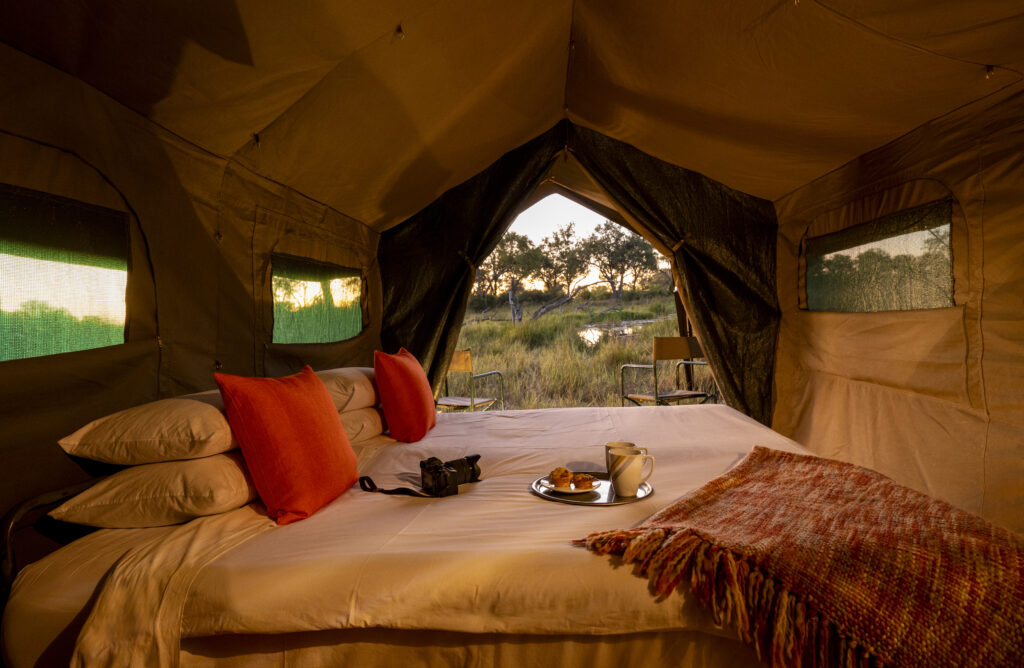
And no, this does not necessarily mean sleeping on the ground and eating canned food. There are certainly very basic mobile camping safaris, but there are also fully serviced luxury mobile safaris with real beds, en-suite toilets, hot bucket showers, proper meals and staff taking care of the camp.
I think it is one of the most interesting ways to experience Botswana, but it is not going to be perfect for everybody.
What Exactly Is a Mobile Safari?
The simplest definition is this: a mobile safari is a safari where a temporary tented camp moves between wilderness areas instead of you moving between permanent lodges.
Botswana has a well-established mobile safari industry. The Hospitality and Tourism Association of Botswana even has a dedicated mobile sector, and its standards require mobile safari companies to hold the appropriate Botswana tourism licenses and permits. You can read more about the requirements in the HATAB standards for Botswana mobile safari operators.
The experience can range from fairly simple camping to what I would call mobile glamping.
On the more comfortable end, you may have a large tent, a proper mattress and bedding, your own toilet, a private shower area, daily housekeeping, laundry and chef-prepared meals.
So when somebody says “mobile safari,” you really need to ask what kind. The words alone do not tell you whether you are getting a sleeping bag and folding chair or something approaching the comfort of a small safari lodge.
If you are deciding between the two styles, I also wrote a separate comparison of a safari lodge vs. tented camp.
The Best Part: Moving Does Not Waste Your Safari Day
This is probably what I like most about the concept.
On a traditional lodge-to-lodge Botswana safari, changing locations can mean packing, checking out, going to an airstrip, waiting for an aircraft, flying to another airstrip, getting picked up and then settling into another lodge.
There is absolutely nothing wrong with that, and flying over the Okavango is an experience in itself. But you are still spending part of your day moving.
On a good mobile safari, the move itself becomes the game drive.
You leave camp with your guide in the morning and start traveling gradually toward the next safari area while looking for wildlife. The camp staff moves separately and takes care of everything else.
You basically spend your day with the animals instead of watching your luggage travel.
For people like us who hate wasting vacation time, that is a pretty big advantage.
Why Botswana Works So Well for Mobile Safaris
Botswana is especially suited to this kind of safari because very different ecosystems sit relatively close to one another in the northern part of the country.
Moremi Game Reserve, for example, combines permanent water, seasonal floodplains, woodland and open savannah. The official Botswana Tourism Organisation guide to Moremi Game Reserve describes it as one of the richest and most diverse ecosystems in the region.
Then you have places such as Khwai, where wildlife moves between the river, floodplains and surrounding woodland, and farther north there is Savuti, which feels completely different again.
Savuti is much drier and is particularly famous for predators. The Botswana Tourism Organisation’s information about Savuti and Linyanti notes its resident populations of lions, cheetahs and hyenas.
This is why moving camp actually makes sense. You are not moving just to say that you visited another place. The landscape and wildlife experience can genuinely change.
Much of this region is connected to the extraordinary Okavango system. UNESCO describes the Okavango Delta as one of the world’s few major inland deltas that does not drain into an ocean, with permanent wetlands and enormous seasonally flooded areas supporting an exceptional variety of wildlife.
What Is It Actually Like to Sleep in a Mobile Camp?
This is probably the question I would ask first.
I love nature, but I also want a toilet.
Fortunately, a luxury mobile safari can be surprisingly comfortable.
You are still in a tent and you are definitely aware that you are in the bush. You will hear animals at night. You may hear elephants, hyenas, birds, insects and occasionally lions far closer than they sound when you are staying inside a large hotel.
But you can still have a proper bed, bedding, private bathroom area and hot shower.
Electricity will normally be more limited than in a permanent lodge. Air conditioning should not be expected. Wi-Fi may be nonexistent, which I personally consider more of a benefit than a problem on safari.
You also need to be comfortable with the fact that this is wilderness. A tent wall is still a tent wall.
That is also the whole point.
You feel much closer to the environment than you do inside a large permanent lodge.
If you have never been on safari before and are wondering what the rest of the day looks like, read our guide to what a typical day on an African safari is really like.
Is a Mobile Safari Better for Wildlife?
No safari style can guarantee better animals because wildlife does whatever it wants. What a mobile safari can give you is more flexibility and more time in the field.
You are not necessarily tied to a lodge schedule where breakfast is at one time, lunch is at another and the vehicle needs to return to camp in between.
Some mobile safaris can stay out all day, stop for lunch in the bush and follow what is actually happening with the wildlife.
For photographers and people who have already done a few safaris, this can be a big deal.
Sometimes the best sighting happens exactly when everybody is supposed to be driving back for lunch.
And personally, if lions are doing something interesting, I would rather watch the lions.
Mobile Safari vs. Lodge Safari
I don’t think one is universally better.
A lodge is better if you want a pool, spa, large room, air conditioning, permanent electricity and the freedom to spend half the afternoon relaxing in your room.
A mobile safari is better if the wilderness itself is the main reason you came.
You generally trade some hotel-style amenities for a more intimate bush experience.
There is also something nice about staying with the same guide and camp team for several days. You get to know each other. Your guide learns that perhaps you don’t need to stop for every giraffe but you will happily spend an hour looking for wild dogs. The whole trip starts feeling more personal.
This is very similar to why I generally prefer private travel over large groups, which I wrote about in our article on private African safaris vs. group travel.
Is a Botswana Mobile Safari Cheaper?
Sometimes, but I would not call Botswana a cheap safari destination.
Mobile camps can remove some of the expense and logistics of flying between multiple permanent lodges, but the safari still requires vehicles, professional guides, camp staff, food, park fees and a surprisingly large amount of equipment to operate in remote wilderness.
So this is not necessarily a budget camping trip.
I would look at it more in terms of value.
You are paying to have your accommodation, food and entire camp operation move through the wilderness while you continue your safari.
Botswana is also one of those countries where accommodation style can change the price enormously. I explain this in more detail in our African safari cost guide.
How Long Should a Mobile Safari Be?
You can do a short stay of several nights in one area, but I think the mobile concept becomes much more interesting once you actually move.
Five or six nights gives you enough time to experience two areas without rushing.
Around nine nights is even better if Botswana is the main purpose of the trip because you can explore several different environments and still spend enough time in each one.
I am generally against trying to collect parks as if they are stamps. More locations do not automatically create a better safari.
Animals are unpredictable. Give yourself time.
Our guide to how many days you really need for an African safari goes into this question in more detail.
Who Will Love a Botswana Mobile Safari?
I think this is a particularly good choice for somebody who comes to Africa primarily for wildlife.
It is also great for photographers, repeat safari travelers and people who enjoy being outside and do not need a resort around them.
It can work very well for a first safari too, especially if you like adventure but still want comfort.
On the other hand, I would probably choose a permanent lodge if having a pool, air conditioning, a very large bathroom, spa treatments or constant internet is an important part of your vacation.
I would also think twice if you are an extremely light sleeper and every sound outside the tent is going to make you wonder whether an elephant is about to walk through your bedroom.
Although, to be fair, hearing elephants outside is one of those experiences you may talk about for the rest of your life.
So, Is a Botswana Mobile Safari Worth It?
For the right traveler, absolutely. I like the idea because it keeps the focus on why you came to Botswana in the first place: the wilderness.
Your camp is comfortable, but it is not the destination. The destination is outside your tent. You wake up in Moremi, spend a day following wildlife through the bush, and a few days later you may be sitting around the same campfire in a completely different landscape.
There is something very old-fashioned about the concept of moving through Africa with your camp, but without having to sacrifice a real bed, good food or a private bathroom. For me, that is a pretty good combination.
One Big Planet offers customizable Botswana and Zimbabwe safari itineraries, including luxury mobile safari options through Botswana. Trips can be built around your available time, desired level of privacy and the wildlife areas you want to explore, and can also be combined with Chobe, Victoria Falls, Zimbabwe or Namibia.
If you are not sure whether a mobile safari or traditional lodge safari is better for you, contact us. Tell us how you normally like to travel, what level of comfort you expect and how much time you have. We can help you decide before you spend a lot of money on the wrong type of safari.